 U.S. stocking partner
Health article
Memory Supplement Red Flags: 8 Checks to Run on NeuroDyne or Any Formula
The biggest red flags are claims of FDA approval, promises to treat Alzheimer's, no Supplement Facts panel, and studies that are not about the product. FDA does not approve supplements before sale (FDA, Using supplements), and the FTC expects human trials of the product or an equivalent formula (FTC, Health claims). NeuroDyne's sales page shows some of these flags, which the checklist below names.
Written by the NeuroDyne editorial teamUpdated · 8 min read
The idea
What counts as a red flag on a memory supplement?
A red flag is any sign that the marketing runs ahead of the evidence. It does not prove a product is bad. It tells you to slow down and check.
The stakes are real. The FDA has sent warning letters about more than 58 products sold as Alzheimer's treatments, including a bacopa product (FDA, Unproven Alzheimer's products). Its main worry: such products can delay a proper diagnosis.
Checklist
Which eight red flags show up most often?
Each row pairs a flag with the rule or source behind it.
| Red flag | Why it matters |
|---|---|
| 1. An approval badge naming the FDA | FDA does not approve supplements before sale (FDA, Using supplements) |
| 2. A registration number shown as proof | Registration does not mean approval or endorsement (21 CFR 1.242) |
| 3. Talk of treating Alzheimer's | Only approved drugs may make disease claims (FDA, Unproven Alzheimer's products) |
| 4. Fast-results promises | FDA warns about lines like "reverse mental decline in just a week" (FDA, False promises) |
| 5. No Supplement Facts panel | Every supplement must carry one |
| 6. Studies of other ingredients | Claims need trials of the product or an equivalent formula (FTC, Health claims) |
| 7. Unverifiable reviews and star counts | The FTC bans fake reviews and testimonials (FTC, Fake reviews rule) |
| 8. Wording such as "clinically proven" | Without a trial of the product, the phrase has nothing behind it |
Precedent
What happened when regulators challenged a memory claim?
They won. In 2017 the FTC and New York State charged the marketers of Prevagen with unsupported memory claims; their own study did not beat placebo on any measure (FTC, Prevagen 2017).
In December 2024 a federal court barred 8 memory statements nationwide after a jury found the science lacking (Prevagen court order, 2024). The lesson for buyers: a confident ad is not evidence.
Evidence
How strong is the evidence behind a typical memory claim?
- BacopaNine trials, 12+ weeks each
Small gains in attention speed at 300-450 mg a day. (Kongkeaw et al., 2014)
- Lion's maneSmall trials of 30-49 people
Mixed results; gains faded after stopping in one trial. (LiverTox, Lion's mane)
- GinkgoThe GEM trial: 3,069 adults
Did not prevent memory decline or dementia over about 6 years. (DeKosky et al., 2008)
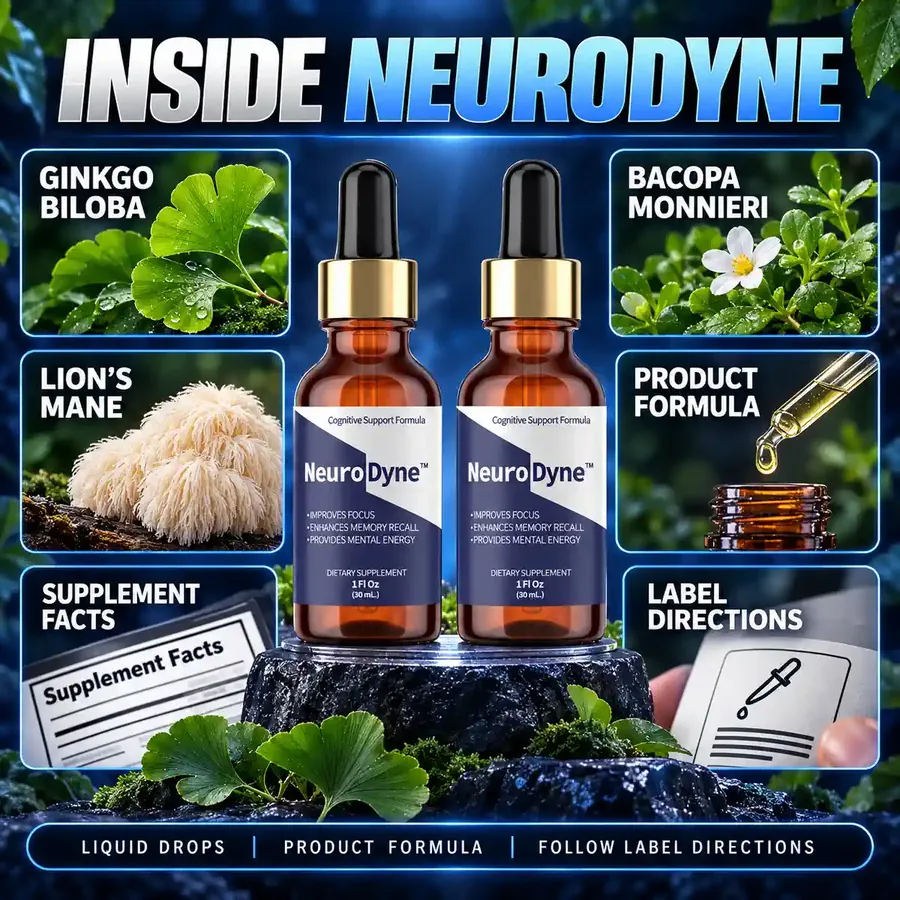
- NeuroDyneNever studied as a product
No trial of NeuroDyne, and no published amounts to compare. (FTC, Health claims)
The longer the bar, the more directly that evidence answers the question: will this bottle help my memory or focus? It sums up the linked sources in our own judgment; it is not a score from any study.
Fair check
How does NeuroDyne do on the same checklist?
Mixed. Some flags apply, and some real strengths stay on the list.
| Check | Result | Detail |
|---|---|---|
| Approval badge | Flag | The sales page shows a badge claiming FDA approval (FDA, Supplement Q&A) |
| Supplement Facts | Flag | No panel or amounts published |
| Study references | Flag | The list cites studies not about these three herbs |
| Product trial | Flag | No study of NeuroDyne exists |
| Disease claims | Clear | The bottle claims focus, recall and mental energy, not treatment |
| Named ingredients | Clear | Ginkgo, bacopa and lion's mane, all widely studied |
| Reviews | Clear here | We show no ratings until they are verified |
| Refund route | Clear | 60-day money-back window and a phone desk at +1 (302) 200-3480 |
More detail on the badges sits on testing and quality.
Try NeuroDyne with 60 days to decide1 fl oz dropper bottle · from $49 a bottle on 6 · free U.S. shipping on 3 or 6
Order nowGood signs
What do green flags look like instead?
A full label
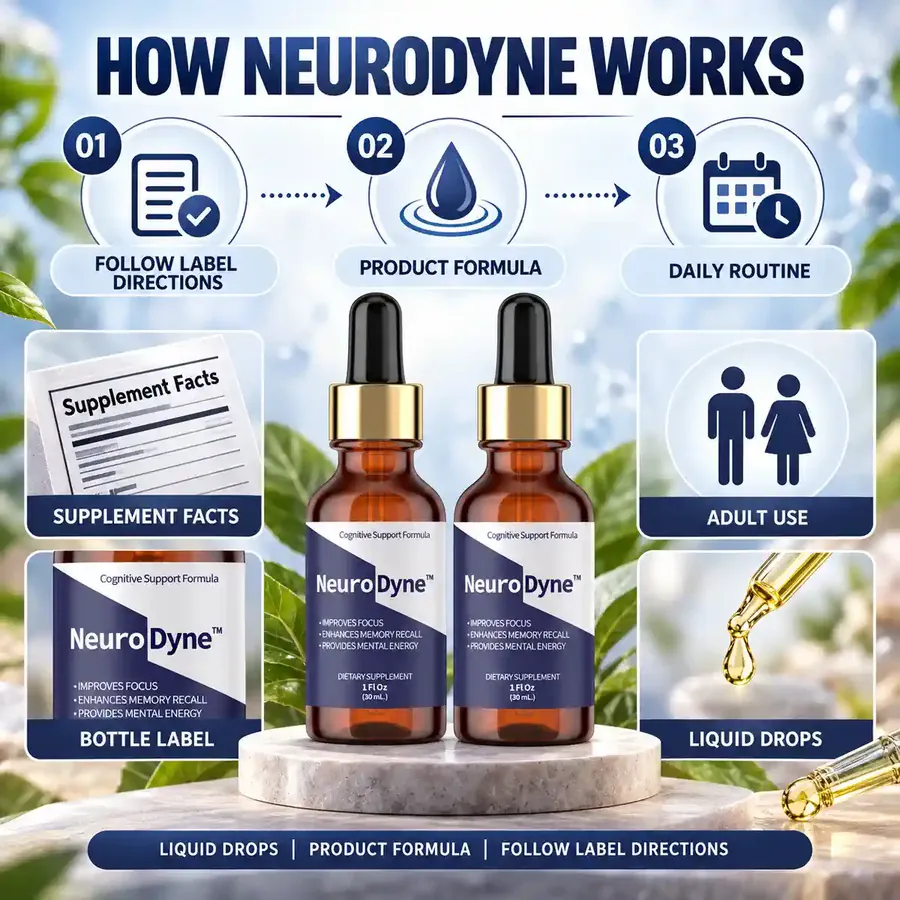
Supplement Facts with milligrams per serving for each herb, and a serving size you can read.
Matching doses
Amounts near the ones studied, such as 300 mg of bacopa extract a day.
Plain claims
Words like "supports" with the FDA disclaimer, and no disease names.
Steps
What should you do before you pay?
- Ask the seller for the Supplement Facts panel and read it.
- Match each herb's amount to the study dose on its page, such as bacopa.
- Ignore star counts you cannot trace to real buyers.
- Show the label to your doctor or pharmacist.
A daughter buying drops for her 66-year-old mother on warfarin should do step 4 first: ginkgo may raise bleeding risk with blood thinners.
Your health
Why can a supplement delay the right diagnosis?
Because months of waiting on a bottle are months without tests. NCCIH says not to use a supplement as a reason to delay seeing a provider about memory loss (NCCIH, 7 things). Common causes such as low B12 and medicine effects are treatable; our brain fog causes article lists them.
References
Sources for this article
- Information for Consumers on Using Dietary Supplements. U.S. Food and Drug Administration, 2022.The FDA cannot approve supplements for safety and effectiveness before they go on sale. The FTC reviews supplement advertising.
- Questions and Answers on Dietary Supplements. U.S. Food and Drug Administration, 2026.The FDA has no authority to approve supplements before they reach the market. Any label with a structure-function claim has to carry the not-evaluated disclaimer.
- 21 CFR 1.242: What does assignment of a registration number mean?. Electronic Code of Federal Regulations, 2026.Being assigned a registration number does not mean FDA approval or endorsement of a facility or its products.
- Unproven Alzheimer's Disease Products. U.S. Food and Drug Administration, 2018.The warning letters named more than 58 products, a bacopa product among them. Such products may delay a proper diagnosis.
- Watch Out for False Promises About So-Called Alzheimer's Cures. U.S. Food and Drug Administration, 2021.Distrust claims such as 'reverse mental decline in just a week'. Check with a doctor before using supplements.
- Health Products Compliance Guidance. Federal Trade Commission, 2022.The FTC expects health claims to rest on competent and reliable science, usually randomized human trials of the product or an equivalent formula.
- Federal Trade Commission Announces Final Rule Banning Fake Reviews and Testimonials. Federal Trade Commission, 2024.It bans fake and AI-generated reviews and testimonials and permits civil penalties.
- FTC, New York State Charge the Marketers of Prevagen With Making Deceptive Memory Claims. Federal Trade Commission, 2017.The charge: the memory claims lacked support, and the study beat placebo on no measure.
- Prevagen ordered to remove all memory-improvement claims. NutraIngredients, on a federal court order of December 2024, 2024.After a jury found the science lacking, a court barred 8 memory statements nationwide.
- 7 Things To Know About Dietary Supplements for Cognitive Function. National Center for Complementary and Integrative Health, 2024.No conclusive evidence ginkgo slows cognitive decline. A supplement is no reason to put off seeing a provider about memory loss.
FAQ
Memory supplement red flag questions
How can you tell if a memory supplement is a scam?
You usually cannot tell from an ad alone, so look for warning signs instead. Common ones are a claim of FDA approval, talk of treating Alzheimer's, no Supplement Facts panel, and studies about other ingredients. One flag is not proof of fraud, but several together are a reason to wait.
Is NeuroDyne checked by the FDA before it is sold?
No. The FDA is not authorized to approve dietary supplements for safety and effectiveness before they reach the market. That applies to NeuroDyne and every other supplement. A badge suggesting otherwise on a sales page is a marketing graphic, and an FDA registration number does not mean approval.
Are online reviews of memory supplements reliable?
Treat them with care. The FTC's 2024 rule bans fake and AI-generated reviews, which shows how common they had become. We publish no NeuroDyne ratings or quotes until they can be verified, so any score you see elsewhere did not come from us.
What should a memory supplement label show?
A Supplement Facts panel with the serving size and the amount of each ingredient per serving. If a proprietary blend is used, FDA rules allow only the total blend weight, with ingredients listed in order by weight. NeuroDyne's panel is not published, so ask the seller for it.
Is NeuroDyne legit?
It is a real product with three named, widely studied herbs and a 60-day money-back window on the sales page. It also carries flags: no published amounts, no study of the product, and a misleading approval badge on the sales page. Weigh both before you buy.
Can a supplement claim to treat Alzheimer's?
No. Only approved drugs can claim to treat a disease. The FDA has sent warning letters to companies selling more than 58 products with Alzheimer's claims. Supplements may only make structure-function claims, such as supporting memory, with the standard FDA disclaimer on the label.
What red flags does the NeuroDyne sales page have?
The page shows a badge that can look like FDA approval, publishes no amounts or Supplement Facts panel, and has no study of the product. The checklist on this page names each one.
How do I spot a fake memory supplement ad like NeuroDyne scam ads?
Be wary of famous names, doctor claims and big promises without proof. Nothing we found shows any celebrity endorses NeuroDyne. Use only the official sales page and check claims against the label.
Who wrote this
Written and reviewed by
Plain-language pages built from the bottle images, the sales page and linked public health sources such as NIH, FDA and Cochrane.
Page revised . Read our editorial standards and the way we check reviews. This website is run by Neurodynesupport, a U.S. stocking partner for NeuroDyne, not by the manufacturer. We are paid a commission when you buy through our order links.
Keep reading
More about NeuroDyne
Testing and quality
Lab reports, badges and FDA rules: which NeuroDyne quality documents exist and which are still missing.
Read moreChoosing a memory supplement
A seven-point label scorecard you can use on any memory bottle, with NeuroDyne scored honestly.
Read moreReviews
Why no NeuroDyne star rating is shown yet, how reviews get matched to real orders, and how to read reviews elsewhere.
Read moreU.S. stocking partner for NeuroDyne
Ready to try NeuroDyne?
Pick a pack. Check your bottle's directions first; each pack lasts through the full 60-day window.
- Secure checkout
- 60-day money-back window
- Tracking in the order email