 U.S. stocking partner
Guide
How to Choose a Memory Supplement: A Label Scorecard, With NeuroDyne Scored
Choose a bottle that shows a Supplement Facts panel with an amount for each ingredient, uses amounts close to those in published studies, and makes modest claims. NeuroDyne names ginkgo, bacopa and lion's mane but publishes no amounts and has no product study. Its strong points are simple liquid drops and a 60-day refund window.
Written by the NeuroDyne editorial teamUpdated
Step one
What should a memory supplement label show?
A Supplement Facts panel. Federal rules require one on every dietary supplement.
FDA labeling rules say every dietary supplement carries a Supplement Facts panel (FDA, Labeling guide). The panel lists the serving size and the amount of each ingredient per serving (21 CFR 101.36). Without it, you cannot compare one bottle with another, or with a study.
One exception trips up shoppers. A "proprietary blend" may show only the blend's total weight, with ingredients listed from most to least by weight (FDA, Labeling guide). You learn the order, but not how much of each herb you get.
The bottle images we have show the front label only. The sales page, checked October 11, 2026, shows no Supplement Facts panel. Our label transcription lists every word we can read and every line we cannot.
The scorecard
How does NeuroDyne score on a seven-point label check?
Use the same seven rows for any memory bottle you are weighing.
| Check | What a strong answer looks like | NeuroDyne today |
|---|---|---|
| 1. Supplement Facts panel | Printed and shown online before you pay | Not published |
| 2. Amount of each herb | Milligrams per serving for every ingredient | Not published |
| 3. Matches study doses | Near 300 mg bacopa extract, for example | Cannot be judged without amounts |
| 4. Study of the product | A human trial of the formula itself | None published |
| 5. Claim wording | "Supports" language with a cited source | Bottle: improves focus, enhances memory recall, provides mental energy |
| 6. Money-back terms | A clear window and a named contact | 60 days per the sales page; order desk at +1 (302) 200-3480 |
| 7. Cost per day | Clear totals, no confusing discounts | $1.63 (6 bottles) to $2.95 (2 bottles) a day |
NeuroDyne passes checks 6 and 7 cleanly. It cannot pass checks 1 to 4 until the maker publishes a panel. A bottle that clears all seven is rare, so weigh which gaps matter most to you.
Amounts
How close are NeuroDyne's amounts to the doses in studies?
Unknown. The bars show the study doses; NeuroDyne's own bars stay empty because nothing is published.
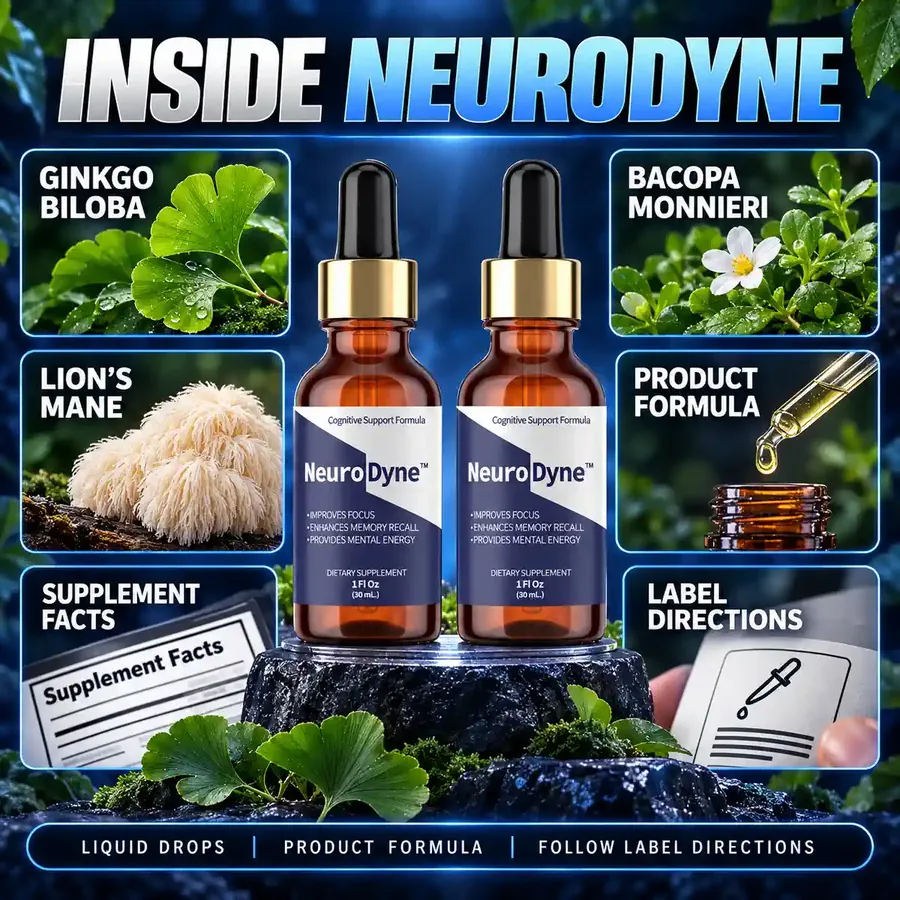
Research used each herb alone, often as a capsule. Bacopa trials gave 300 to 450 mg of extract a day (StatPearls, Bacopa). The GEM trial gave 240 mg of ginkgo a day (DeKosky et al., 2008). Lion's mane trials ranged from 1,050 mg to about 3 g a day (Li et al., 2020) (Mori et al., 2009).
One 30 mL bottle must cover a month. Fitting three herbs at those levels into about 1 mL a day may not be possible, though we cannot say for sure without the panel. Ask the maker for the milligrams per dropper before you judge.
Red flags
Which marketing claims should make you look closer?
Four patterns come up again and again on memory supplement ads.
An "FDA" badge that implies approval
The FDA is not authorized to approve dietary supplements before they are sold (FDA, Using supplements). A facility registration number does not mean approval either (21 CFR 1.242). NeuroDyne's sales page shows an FDA-style badge; read it as decoration, not a review.
Disease words
Supplements may not claim to treat Alzheimer's or dementia. The FDA has sent warning letters about more than 58 such products, one of them a bacopa product (FDA, Unproven Alzheimer's products).
Testimonials with no proof
The FTC banned fake and AI-written reviews in 2024 (FTC, Fake reviews rule). We publish no NeuroDyne star ratings or quotes until reviews can be verified.
References that do not match
Check that cited studies are about the ingredients in the bottle. Some studies cited on the NeuroDyne sales page are on other ingredients, not ginkgo, bacopa or lion's mane.
The bar regulators use is high. The FTC expects competent and reliable scientific evidence for health claims, generally human trials of the product or an equivalent formula (FTC, Health claims). One memory brand was ordered by a federal court in 2024 to drop 8 memory statements (Prevagen court order, 2024).
Format
Do liquid drops work better than capsules?
No study shows that. Drops are easier to take; capsules can hold more herb per dose.
Drops help people who dislike swallowing pills, and the dropper makes the amount easy to repeat. That is a real plus for many readers over 60.
The trade-off is volume. A capsule holds a few hundred milligrams of dry extract. A dropper of liquid must share its space with the base, which may be alcohol or glycerin. NeuroDyne does not say which, so anyone avoiding alcohol should ask the maker.
Every trial behind these three herbs used capsules or tablets of a single herb. Whether a mixed liquid acts the same way has not been tested.
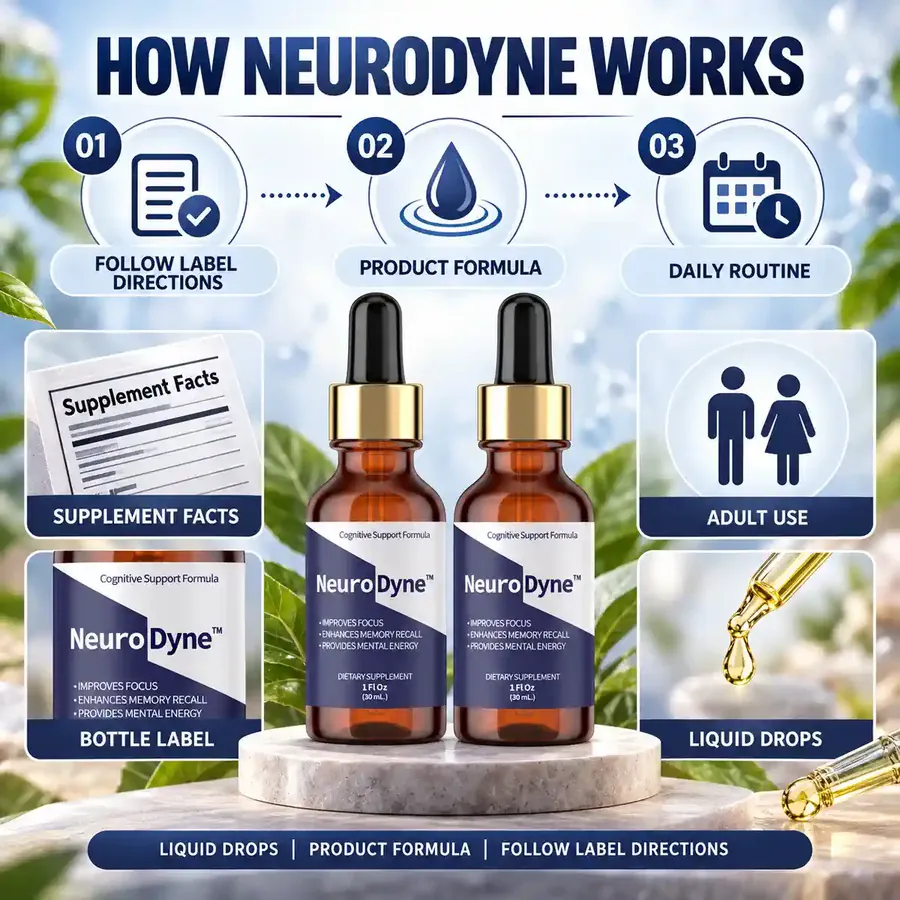
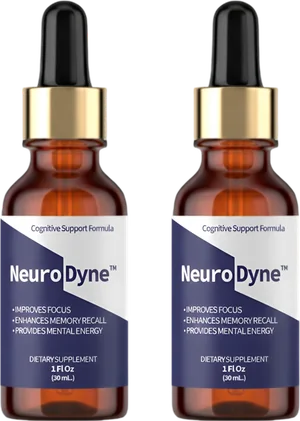
Try NeuroDyne with 60 days to decide1 fl oz dropper bottle · from $49 a bottle on 6 · free U.S. shipping on 3 or 6
Order nowIn numbers
What do the known NeuroDyne numbers add up to?
Check first
Who should not choose a memory supplement alone?
Some readers need a doctor in the decision, whatever the brand.
Think of a 66-year-old on warfarin whose daughter wants to buy her drops. With blood thinners, ginkgo may raise bleeding risk (NCCIH, Ginkgo), so the doctor who manages the warfarin should see the bottle first. The same goes for anyone with surgery planned.
- Seizure, diabetes, mood or memory medicines: ask before adding any herb.
- Mushroom allergy: lion's mane is a mushroom.
- Pregnant, nursing or under 18: these herbs have not been studied for safety in those groups.
- New or fast memory loss: see a doctor before buying anything. Causes such as low B12 can be treated (MedlinePlus, Memory loss).
Before you pay
What should you do in the five minutes before you order?
Five steps, any brand.
Find the panel
Look for a Supplement Facts panel on the product page. If none is shown, email the seller and ask for it.
Compare the amounts
Put each milligram figure next to the study dose. Far below the study dose means the study tells you little.
Read the claims
Watch for disease words, approval badges and unverified star ratings.
Check with your doctor
Bring the label if you take blood thinners or other daily medicines.
Note the refund rules
Write down the window, the contact and who pays return shipping before you pay.
For a wider look at habits and causes, read the memory and focus guide. To weigh a blend against buying one herb on its own, see NeuroDyne vs single-ingredient supplements. Pack totals sit on the pricing page.
FAQ
Questions about choosing a memory supplement
What should I look for in a memory supplement?
Look for a Supplement Facts panel with an amount for every ingredient, amounts near those used in studies, modest claims and clear refund terms. A study of the finished product is rare. Bottles that hide amounts are hard to judge against any research.
Is a proprietary blend bad?
Not always, but it hides the amount of each ingredient. The label must show the blend's total weight and list ingredients from most to least, yet you cannot tell whether any one herb reaches a studied dose.
How do I know if a memory supplement is legit?
Check that it shows a full label, cites studies of its own ingredients, avoids disease claims and lists a working phone number. NeuroDyne shows a contact phone and a 60-day refund window, but no panel or amounts yet.
Does the FDA check memory supplements before they are sold?
No. The FDA is not authorized to approve dietary supplements for safety and effectiveness before they reach shelves. It can act after sale, and the FTC polices advertising claims.
Are liquid memory supplements better absorbed?
No study we found shows that for ginkgo, bacopa or lion's mane. Research on these herbs used capsules or tablets. Drops are easier to swallow, which is a fair reason to prefer them.
What is a good price for a memory supplement per day?
Work out the cost per day, not per bottle. NeuroDyne runs $2.95 a day on 2 bottles, $2.41 on 3 and $1.63 on 6, per the sales page. A cheaper bottle with published amounts may be better value.
Should I buy a single herb instead of a blend?
A single herb, such as a bacopa capsule with a printed dose, is easier to match to a study. A blend is simpler to take. Neither choice has been compared head to head for NeuroDyne.
Who wrote this
Written and reviewed by
Plain-language pages built from the bottle images, the sales page and linked public health sources such as NIH, FDA and Cochrane.
Page revised . Read our editorial standards and the way we check reviews. This website is run by Neurodynesupport, a U.S. stocking partner for NeuroDyne, not by the manufacturer. We are paid a commission when you buy through our order links.
Keep reading
More about NeuroDyne
Memory and focus guide
Causes a doctor can check, habits that help recall, and an honest look at where three herbs fit.
Read more
NeuroDyne vs single herbs
Three herbs in one dropper, or one herb at a known dose: a fair comparison with a full side-by-side table.
Read more
Guarantee
What the 60-day NeuroDyne guarantee covers, what it leaves out, and how to use it without missing the deadline.
Read moreU.S. stocking partner for NeuroDyne
Ready to try NeuroDyne?
Pick a pack. Check your bottle's directions first; each pack lasts through the full 60-day window.
- Secure checkout
- 60-day money-back window
- Tracking in the order email