 U.S. stocking partner
The basics
How Does NeuroDyne Work? Three Herbs in a Daily Dropper
NeuroDyne delivers three herbs, ginkgo, bacopa and lion's mane, as liquid drops taken as part of a daily routine.
Each herb has been studied on its own, mostly as capsules. The bottle holds 1 fl oz (30 mL), and the maker does not list the amount of each herb (FTC, Health claims).
Written by the NeuroDyne editorial teamUpdated
In brief
What does NeuroDyne actually do?
The plain answer: NeuroDyne delivers three herbal ingredients in liquid form. The bottle says it improves focus, enhances memory recall and provides mental energy. Those are the maker's words, not test results.
The product is a dietary supplement in a 1 fl oz (30 mL) amber dropper bottle. Per the sales FAQ, a single bottle is a 30-day supply. The named ingredients are ginkgo biloba, Bacopa monnieri and lion's mane mushroom.
What the bottle does not tell you matters just as much. No Supplement Facts panel appears in any product image. The sales page, checked on October 11, 2026, does not publish one either. So the amount of each herb per serving is unknown.
The brand's own explanation
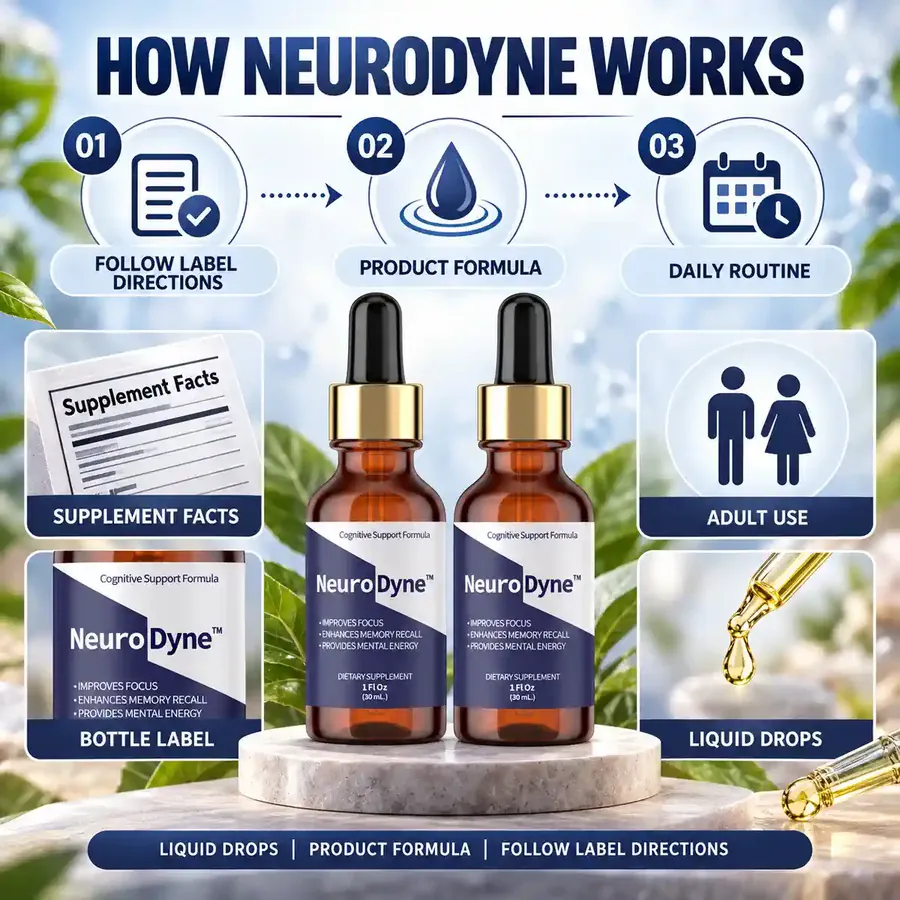
The brand graphic breaks the idea into three panels. Panel 01 says to follow label directions. Panel 02 points to the formula. Panel 03 asks for a daily routine.
None of the three panels gives a dose, a mechanism or a study. Treat the graphic as a reminder to read your bottle, not as evidence.
Ingredients
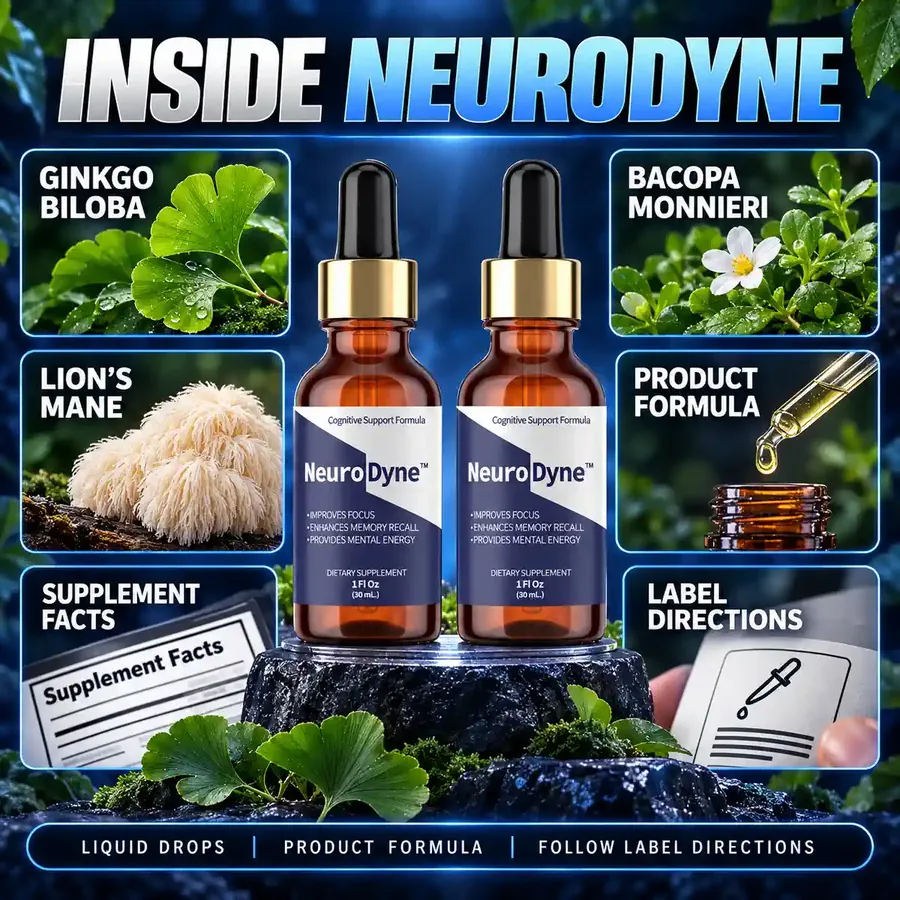
Which three herbs are inside NeuroDyne?
Three names, zero amounts. Each herb has its own research record.
Ginkgo biloba
A tree-leaf extract sold for memory and circulation. The largest trial ran about 6 years in older adults. Read the details on the ginkgo biloba page.
Bacopa monnieri
An Ayurvedic herb tested for memory and attention. Its trials all lasted 12 weeks or longer. See the bacopa monnieri page.
Lion's mane mushroom
A mushroom sold for focus and memory. Human trials are small, with 30 to 49 people each. More on the lion's mane page.
Research
What did studies of each herb measure?
Each line is a study of one herb taken alone, not of NeuroDyne.
| Herb and study | People | Daily amount | Length | Main finding |
|---|---|---|---|---|
| Bacopa, 9-trial review (Kongkeaw et al., 2014) | 518 | 300-450 mg extract (StatPearls, Bacopa) | 12+ weeks | Small gains in speed of attention |
| Ginkgo, GEM trial (DeKosky et al., 2008) | 3,069 adults 75+ | 240 mg (120 mg twice) | Median 6.1 years | No drop in dementia: 17.9% vs 16.1% on placebo (GEM trial results, 2008) |
| Lion's mane, Mori 2009 (Mori et al., 2009) | 30 with mild cognitive impairment | About 3 g | 16 weeks | Scores rose, then fell 4 weeks after stopping |
| Lion's mane, Docherty 2023 (Docherty et al., 2023) | 41 healthy young adults | 1.8 g | 28 days | Mostly no change |
| Lion's mane, Li 2020 (Li et al., 2020) | 49 | 1,050 mg | 49 weeks | Main memory scores did not differ; authors worked for the supplier |
| NeuroDyne itself | No study | Not published | None | None |
A Cochrane review of 36 ginkgo trials called the evidence inconsistent and unreliable (Cochrane, Ginkgo 2009).
At a glance
How big were the study doses, and how long did they run?
Study doses come from the linked trials (StatPearls, Bacopa) (DeKosky et al., 2008) (Mori et al., 2009) (Li et al., 2020). With no published amounts, NeuroDyne cannot go on either chart. Those studies tested single-ingredient capsules or tablets, not a mixed liquid.
Format
Why does a liquid bottle limit the amounts?
Space is the short answer. A whole month of NeuroDyne shares 30 mL of liquid, which is about two tablespoons.
Compare that with the lion's mane studies. At 1.8 g a day, a month of Docherty's dose adds up to 54 g of material. At about 3 g a day, Mori's dose adds up to roughly 90 g in a month.
Extracts can be concentrated, so this math does not prove the amounts are low. It does mean they may be far below study doses. Only the maker knows, because the panel is not published.
Drops are often made with alcohol or glycerin. We cannot tell which one NeuroDyne uses. If you avoid alcohol, ask the maker before you order.
Try NeuroDyne with 60 days to decide1 fl oz dropper bottle · from $49 a bottle on 6 · free U.S. shipping on 3 or 6
Order nowExpectations
Does NeuroDyne work like coffee?
No. None of the three named herbs is a stimulant, so you should not expect a quick lift the way caffeine gives one.
For scale, FDA says up to 400 mg of caffeine a day is not generally linked to harm in healthy adults (FDA, Caffeine). Caffeine acts within the hour. Bacopa, by contrast, was only tested over 12 weeks or more (StatPearls, Bacopa).
NeuroDyne is also not a medicine. It is not a treatment for dementia, Alzheimer's disease or ADHD, and its label claims are structure-function statements that FDA does not evaluate (FDA, Supplement Q&A).
Low vitamin B12, side effects of medicines, heavy drinking, depression and stroke can all affect memory (MedlinePlus, Memory loss). A doctor can check these. Sudden confusion or trouble speaking means call 911.
Evidence
How strong is the link from herb to bottle?
The further a study sits from the actual product, the weaker the answer it gives.
- BacopaNine trials, 12+ weeks each
Small gains in attention speed at 300-450 mg a day. (Kongkeaw et al., 2014)
- Lion's maneSmall trials of 30-49 people
Mixed results; gains faded after stopping in one trial. (LiverTox, Lion's mane)
- GinkgoThe GEM trial: 3,069 adults
Did not prevent memory decline or dementia over about 6 years. (DeKosky et al., 2008)
- NeuroDyneNever studied as a product
No trial of NeuroDyne, and no published amounts to compare. (FTC, Health claims)
The longer the bar, the more directly that evidence answers the question: will this bottle help my memory or focus? It sums up the linked sources in our own judgment; it is not a score from any study.
The FTC expects health claims to rest on competent and reliable science, generally trials of the product or an equivalent formula (FTC, Health claims). For NeuroDyne, the bottom rung is empty.
Checklist
What should you confirm before relying on NeuroDyne?
Three facts would change how useful NeuroDyne could be. You can ask the maker for each one.
- The amount of ginkgo, bacopa and lion's mane in one serving, in milligrams.
- Whether the extracts are standardized, and to what.
- The full ingredient list, including the liquid base and any flavoring.
- The serving size and directions printed on the back of the bottle.
Our label and supplement facts page tracks what has been published so far. Once your bottle arrives, read the back panel before the first dose.
Trying it
What does a fair test of NeuroDyne look like?
A fair test is long, steady and written down. Pick one daily time, use the amount on your bottle and keep notes once a week.
Example: a 58-year-old project manager who loses names in meetings might count how often it happens each week. That gives her a number to compare at week 8, instead of a vague feeling.
The sales page offers a 60-day money-back window, which ends before the 12-week mark seen in bacopa trials. Our results timeline shows how to plan around that gap.
FAQ
Questions about how NeuroDyne works
How does NeuroDyne work in the brain?
Nobody has shown how NeuroDyne works, because the product has never been studied. Ginkgo, bacopa and lion's mane are the herbs the sales FAQ names. Each was tested alone, mostly as capsules, with small or mixed results. Without published amounts, no one can say whether a dropper delivers a meaningful dose.
Is NeuroDyne a stimulant?
No, none of the three named herbs is a stimulant. Do not expect a caffeine-style kick. Caffeine is not listed among the named ingredients, but the full list is not published, so ask the maker if you need to avoid it completely.
How much bacopa is in NeuroDyne?
The amount of bacopa in NeuroDyne is not published. Bacopa studies used 300 to 450 mg of extract a day for at least 12 weeks. Ask the maker for the milligrams per serving before you compare it with that research.
Why is NeuroDyne a liquid instead of a capsule?
The maker has not explained the choice. Liquid drops suit people who dislike swallowing pills. The trade-off is space: one 30 mL bottle must hold a month of servings, which may limit how much of each herb fits.
Has NeuroDyne been clinically tested?
No clinical trial of NeuroDyne has been published. The research cited for memory supplements like it covers single herbs at known doses. The FTC generally expects trials of the product or an equivalent formula to back health claims.
Does NeuroDyne contain alcohol?
We cannot tell, because the Supplement Facts panel and ingredient list are not published. Many liquid supplements use alcohol or glycerin as a base. If you avoid alcohol for health, recovery or faith reasons, ask the maker before ordering.
Can NeuroDyne treat memory loss?
No, NeuroDyne is a dietary supplement and is not a treatment for memory loss, dementia or Alzheimer's disease. New or worsening memory problems have treatable causes, such as low B12 or medicine side effects, and deserve a doctor's visit.
Who wrote this
Written and reviewed by
Plain-language pages built from the bottle images, the sales page and linked public health sources such as NIH, FDA and Cochrane.
Page revised . Read our editorial standards and the way we check reviews. This website is run by Neurodynesupport, a U.S. stocking partner for NeuroDyne, not by the manufacturer. We are paid a commission when you buy through our order links.
Keep reading
More about NeuroDyne
Ingredients
Ginkgo, bacopa and lion's mane are named. The amounts are not. Each herb next to the doses studies used.
Read more
Supplement Facts
The NeuroDyne front label typed out, the three named herbs, and the panel details that are still missing.
Read moreResults timeline
Why any change would take weeks, how study lengths compare, and how the 60-day window fits in.
Read moreU.S. stocking partner for NeuroDyne
Ready to try NeuroDyne?
Pick a pack. Check your bottle's directions first; each pack lasts through the full 60-day window.
- Secure checkout
- 60-day money-back window
- Tracking in the order email